Bimetallic Cladding Pipe
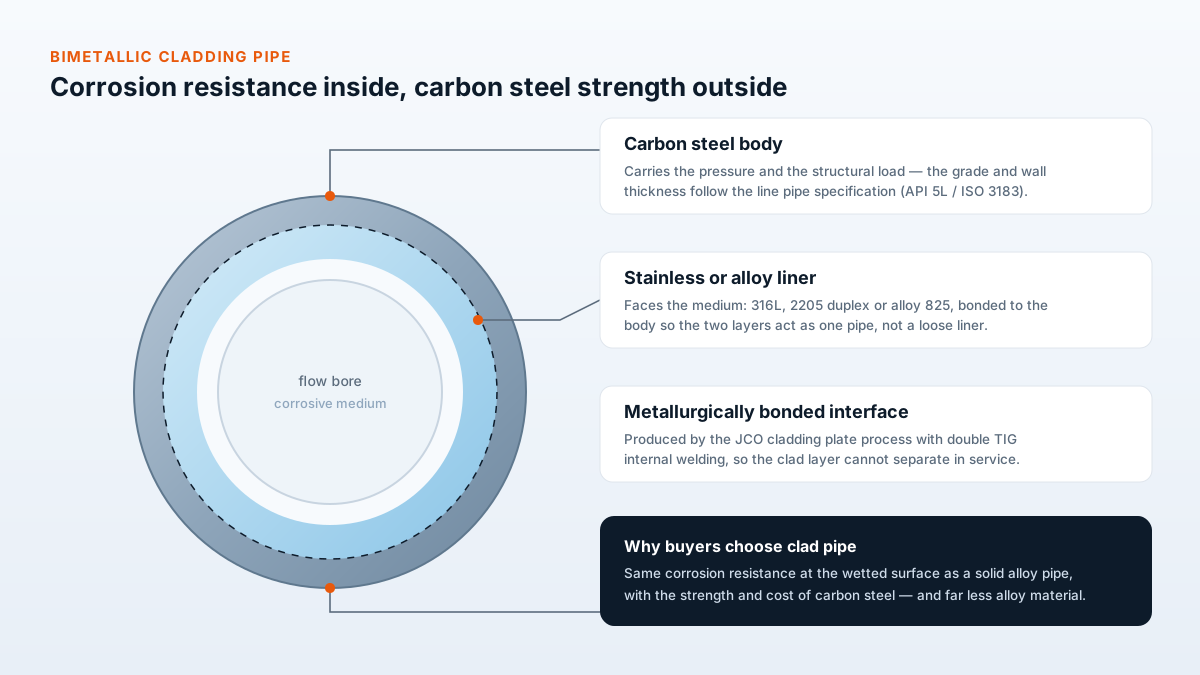
A stainless or alloy liner bonded to a carbon steel body: the corrosion resistance of the liner, with the strength and cost advantage of carbon steel — and a significant saving of precious alloy material.
Why bimetallic pipe is used
Corrosion is solved at the surface, but pressure containment and structural strength come from the wall. A clad pipe separates the two duties: the liner faces the medium, the carbon steel body carries the load. Compared with solid stainless or high-alloy pipe, this reduces both material cost and the use of scarce alloy material, while keeping the corrosion resistance the process requires.
- Corrosion resistance of stainless or alloy steel at the wetted surface
- High strength and lower cost from the carbon steel body
- Substantial saving of precious alloy material
- Widely used in oilfield construction and refining
How it is produced
Production uses the existing two JCOE straight-seam submerged arc welded pipe lines, together with new double tungsten inert gas (TIG) automatic internal welding equipment. The cladding plate or coil is formed by the JCO process, so the liner and the body are combined into a metallurgically bonded composite pipe with a mature, repeatable process route.
Application scenarios
1. Oilfield gathering and injection lines with CO₂ or H₂S. Corrosive produced fluids attack the internal surface; the liner provides the resistance while the carbon steel body keeps the pipe economical and weldable in the field.
2. Refinery and petrochemical process piping. Where a process stream would require a solid alloy pipe, a clad pipe can often be substituted — reducing cost while keeping the same corrosion performance at the wetted surface.
3. Water and desalination duty. Stainless lined pipe for chloride-containing water where a fully stainless line would be uneconomic at the required diameter.
What to send for a quotation
- Liner material and thickness (for example 316L, 2205 or alloy 825)
- Base pipe grade and wall thickness
- Outside diameter, length and quantity
- Medium, operating temperature and pressure
- Welding and inspection requirements, including any clad weld testing
| Product | Bimetallic cladding pipe (LSAW / JCO clad plate process) |
|---|---|
| Construction | Corrosion-resistant liner + carbon steel body, metallurgically bonded |
| Liner material | Stainless or alloy, to project specification |
| Base pipe | Carbon steel line pipe — Ø406 – Ø1422 mm range |
| Welding | Submerged arc welding outside, double TIG automatic welding inside |
| Inspection | Weld and clad inspection, NDT, dimensional inspection, CNAS laboratory |
| Documentation | EN 10204 3.1 certificate, test reports, welding records |
| Main applications | Oilfield construction, refining and corrosive process service |
| Incoterms | FOB / CFR / CIF / DAP |
Bimetallic pipe questions
How is the liner bonded to the base pipe?
The cladding plate or coil is formed by the JCO process and welded into a pipe, with double tungsten inert gas automatic internal welding. The liner and body are combined metallurgically, so the composite behaves as one pipe rather than a loose liner that could separate.
How do I decide between a clad pipe and a solid alloy pipe?
It comes down to the corrosion allowance and the required wall thickness. Where the corrosion resistance is only needed at the surface and the pressure duty is carried by a thicker wall, a clad pipe is usually the more economical solution. Send the medium and design conditions and we will compare the options.
Can the clad pipe be welded on site?
Yes, with a welding procedure appropriate to the clad construction. Please tell us the field welding route at the inquiry stage so the pipe-end preparation and any test requirements can be aligned with your construction procedure.
Compare clad pipe against solid alloy
Send the medium, temperature and pressure — we will come back with the specification and price.