Hydrogen & CO₂ Transmission Pipe
Pipe for the two media that decide the next generation of pipelines: hydrogen, where embrittlement and leakage dominate the design, and supercritical CO₂, where low-temperature toughness is the critical property.
Choosing the external coating for a hydrogen line? Read Hydrogen pipeline coating: SFBE, DFBE or 3LPE — how to choose.
Hydrogen transmission pipelines
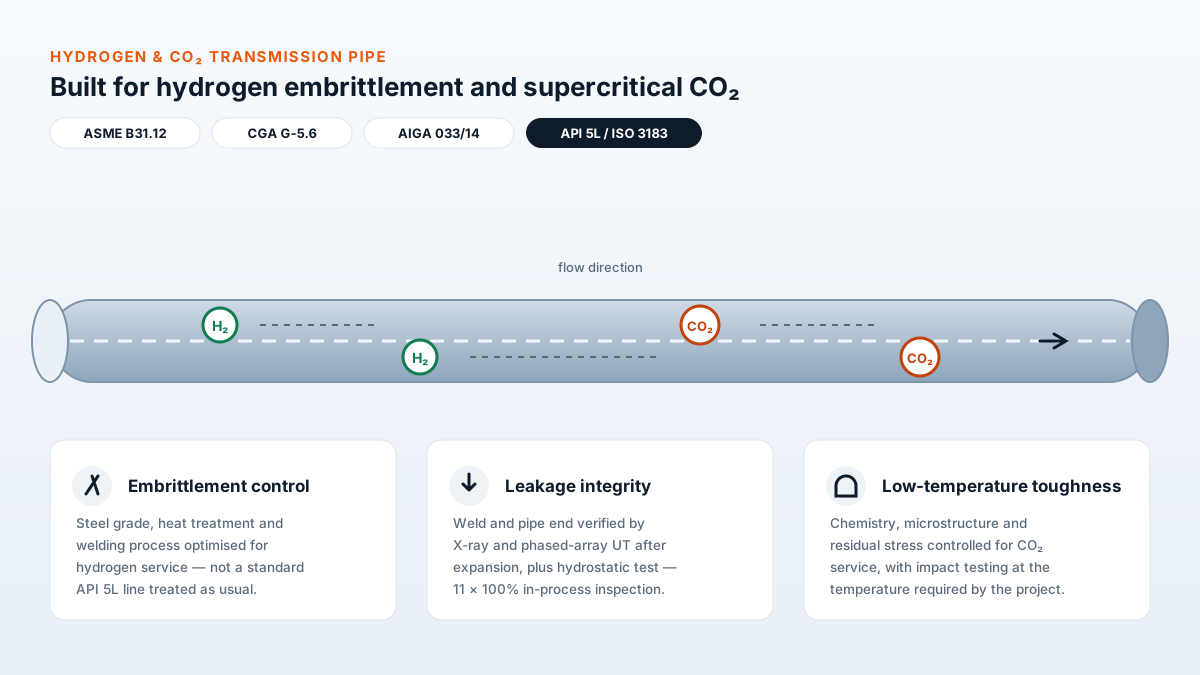
Large-scale new-energy application is shifting towards hydrogen, and pipeline transport is the most economical route. The influence of hydrogen on pipeline material appears in three ways: hydrogen embrittlement, hydrogen corrosion and hydrogen leakage. Once the risk was identified, the steel grade, heat treatment and welding process were optimised specifically for hydrogen transmission service.
Pipe has been supplied into the hydrogen service pipelines of the Perdaman Ceres project in Australia — the world's largest urea base — with the hydrogen service pipelines of that project covered, and experience accumulated in both hydrogen and pure-hydrogen pipeline research and production. The company has also been shortlisted as a participating unit in the compilation of the Chinese Technical Specification for Design of Pipes for Long-Distance Hydrogen Pipeline Lines.
Executive standards: ASME B31.12 CGA G-5.6AIGA 033/14
Supercritical CO₂ transmission pipelines
For pipe used in supercritical CO₂ transportation, high strength, high toughness and good weldability are the starting point — not the finish. The material must also resist low-temperature embrittlement and CO₂ corrosion. Work has therefore focused on the mechanisms that actually cause failure: medium corrosion, leakage diffusion and crack propagation, with attention to alloy composition, microstructure, geometric dimensions and residual stress.
What this means for your specification
- Grade selection is not simply “as hard as possible” — hardness and chemistry are controlled against embrittlement
- Heat treatment is specified with the welding procedure, not independently of it
- Weld integrity is verified by X-ray before and after expansion plus phased-array UT
- Impact and hardness testing are carried out at the temperature relevant to the service
| Product | LSAW (JCOE) pipe for hydrogen and CO₂ transmission |
|---|---|
| Hydrogen standards | ASME B31.12 · CGA G-5.6 · AIGA 033/14 |
| Base standard | API 5L / ISO 3183 PSL2, project specification |
| Production line | 2# new-energy JCOE workshop |
| Outside diameter | Ø406 – Ø1016 mm (16" – 40") |
| Wall thickness | 6.35 – 35.71 mm, depending on diameter and grade |
| Grades | L245 to L555 / Gr.B to X80, optimised for hydrogen service |
| Key controls | Steel grade, heat treatment, welding process, microstructure, residual stress |
| Inspection | 11 × 100% in-process inspection, CNAS laboratory |
| Reference project | Hydrogen service pipelines — Perdaman Ceres urea base, Australia |
| Incoterms | FOB / CFR / CIF / DAP |
Where this pipe is being specified
Hydrogen blending and pure H₂ lines
Transmission and distribution lines where the percentage of hydrogen determines the acceptable grade, hardness limit and test programme.
Ammonia and urea complexes
Hydrogen service piping inside fertiliser and ammonia plants, where continuous operation and leak-tightness are critical.
CCUS and CO₂ transport
Dense-phase and supercritical CO₂ pipelines where low-temperature toughness and resistance to CO₂ corrosion decide material selection.
Hydrogen & CO₂ pipe questions
Can ordinary API 5L pipe be used for hydrogen?
Not automatically. Hydrogen changes the failure behaviour of steel through embrittlement and crack growth, so the grade, hardness, chemistry and welding procedure have to be reviewed against the hydrogen partial pressure and the applicable code — ASME B31.12, CGA G-5.6 or AIGA 033/14. We review the service conditions and confirm the pipe specification rather than treating it as a standard line.
What is the decisive property for supercritical CO₂ pipe?
Low-temperature toughness, together with toughness in the weld and heat-affected zone. Strength is comparatively easy to achieve; resistance to crack propagation is what has to be designed and tested.
Do you have reference experience in hydrogen service?
Yes — hydrogen service pipelines for the Perdaman Ceres project in Australia, described as the world's largest urea base, with the hydrogen service pipelines of that project supplied, plus participation in the compilation of China's technical specification for long-distance hydrogen pipeline design.
Discuss your hydrogen or CO₂ specification
Send the design conditions — we will come back with the grade, wall thickness and test programme.